

Context & Scope
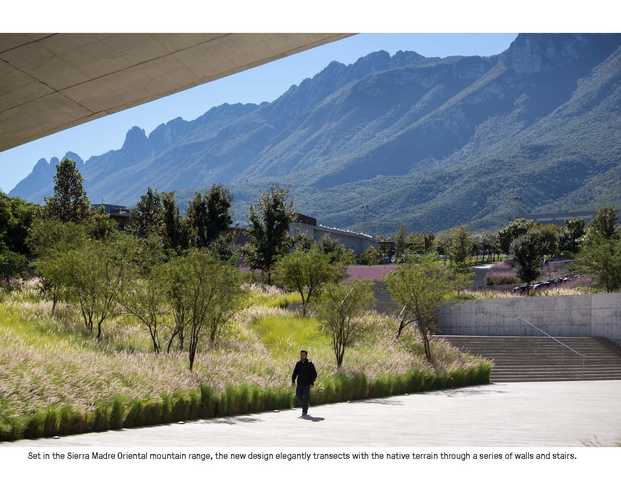
Set in the foothills of the Sierra Madre Oriental range in the state of Nuevo Leon, Mexico, the campus for the Universidad de Monterrey (UDEM) embodies the rugged and majestic character of its regional landscape. It is this dramatic setting that inspired Japanese architect Tadao Ando to envision his design for the Centro Roberto Garza Sada (RGSC), the new home for the art and architecture departments at the university which includes spaces for design, research, teaching and exhibition, as well as laboratories and workshops. It is a monumental structure of exposed concrete with a sharp lifting at the center of the volume that forms a visual frame of the mountains and city beyond. Named the “Gate of Creation”, it is an architectural benchmark in Latin American, representing an exceptional example of building design that works in harmony with the site upon which it is located.
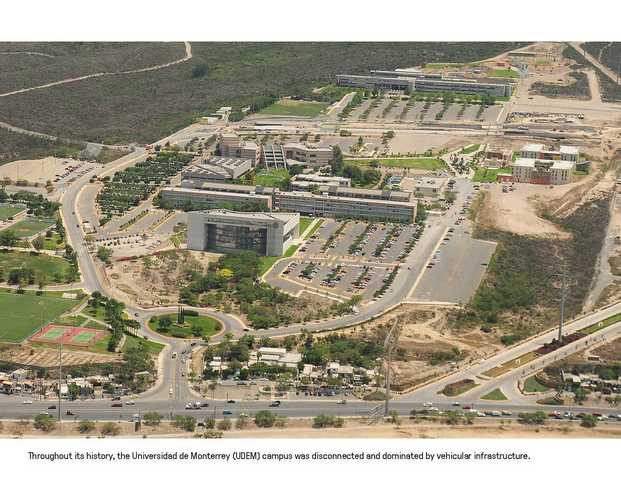
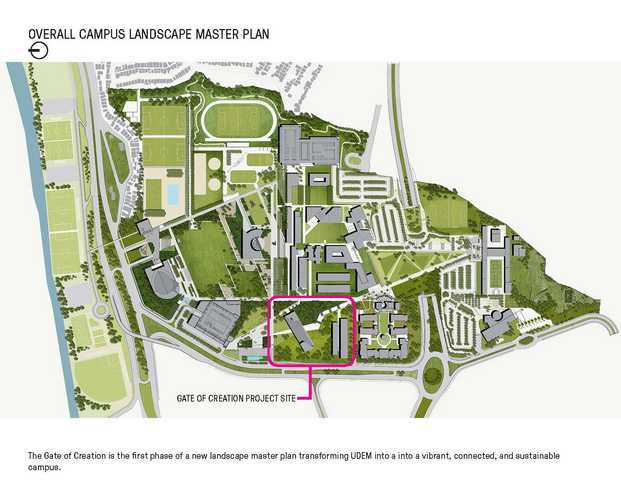
The landscape architecture team provided overall campus master planning services for the Universidad de Monterrey with the intent of transforming a resource-consumptive landscape, disconnected and dominated by vehicular infrastructure, into a healthy, connected, vibrant, and ecologically sustainable academic campus. As the first phase to be implemented under this new master plan, the building and landscape that comprise the RGSC project needed to establish the precedent to which all future phases will adhere. The landscape design team worked very closely with the architect on siting the building, site grading, and material selection. The new design envisions the landscape as an extension to the academic setting, reflecting local culture and ecology. All plant material is native to the Monterrey region, and all site material, including metal work, paving, and site furnishings, are locally sourced. Extensive effort was made to integrate local craft into the project. This contributed to the project receiving the first LEED gold certification in Mexico. The landscape architecture team provided full services from schematic design through construction implementation.
Design Intent & Materials
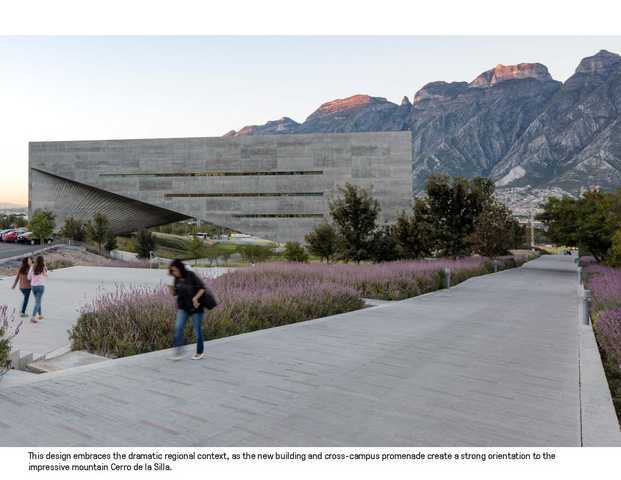
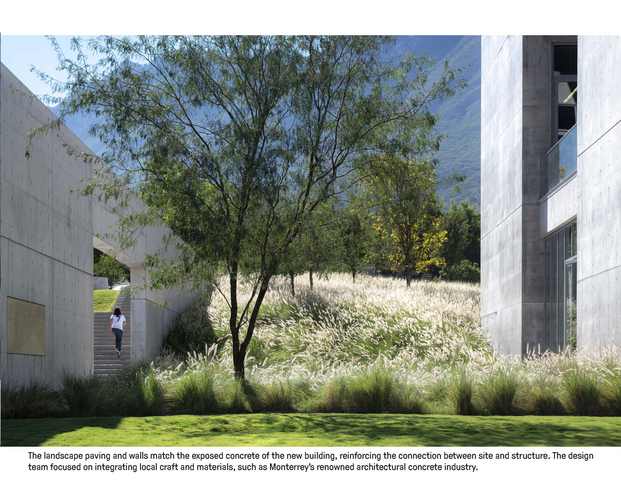
The landscape design compliments the architect’s vision without competing or detracting from it. The topography of the site descends from south to north with an elevation change of 10 meters, requiring a series of retaining walls, terraces and stairs. All of these elements transect elegantly into the adjacent terrain, creating a deliberate procession as views of the building and the countryside unfold for pedestrians moving through the site. The primary circulation path leads directly under the twisting arch of the RGSC, framing an incredible view of the Cerro de la Silla (Saddle Mountain), a towering peak that the City of Monterrey has adopted as their unofficial symbol. The walls and flatwork match the color and finish of the RGSC’s exposed concrete, further establishing the connection between the site and the structure. As part of the effort to integrate local craft and materials into the project, the design team worked extensively with the representatives from Monterrey’s renowned architectural concrete industry to detail and develop these site elements.
A fully accessible circulation route borders the site to the east, a segment in a grand promenade that traverses the full campus from north to south. Previously an over-scaled asphalt drive and parking lot slicing across the academic quad, the new promenade now provides a clear and comfortable connection into the adjacent Student Center. On the site’s northern edge, the circulation paths connect to the future location for grand Main Entry Plaza for the UDEM campus, a space that will also act as the forecourt to the RGSC.
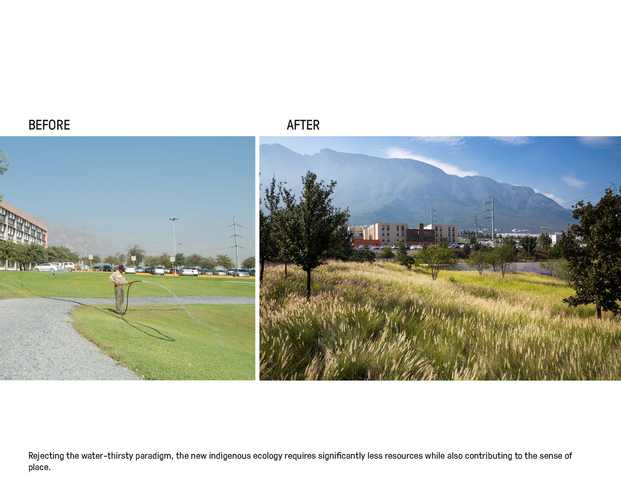
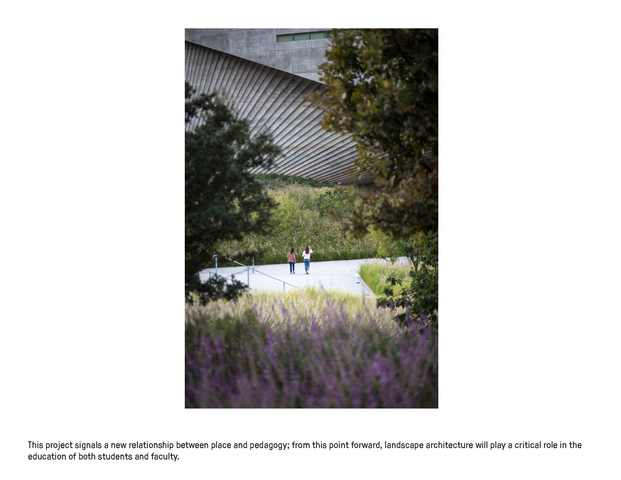
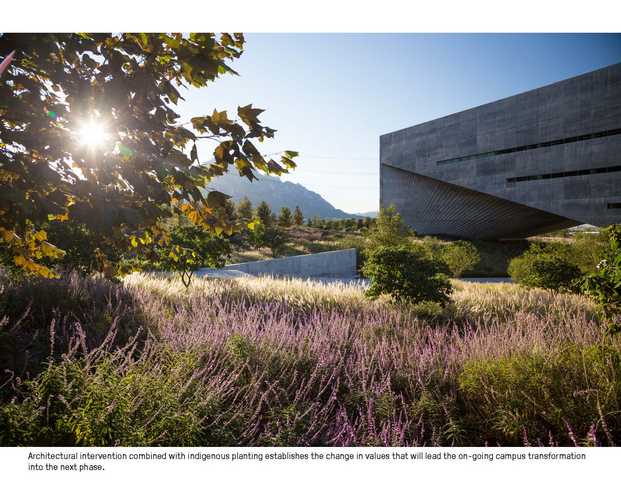
The planting design seeks to celebrate the local botanical color and structure while also harnessing the physical elements present on-site. Plant selections are massed in large swathes, punctuating their vibrant character, that cascade over the rolling terrain. As pedestrians navigate through the site, they are enveloped in successive waves of Pennisetum alopecuroides (Fountain Grass), Ruellia brittoniana (Common Ruella) and Salvia leucantha (Mexican Sage). The landscape is punctuated with sculptural tree selections Cordia boissieri (Mexican Olive), Prosopis pubescens (Mesquite Tree) and Quercus polymorpha (Monterrey Oak). These native and native-adapted selections provide a deeper connection to the regional ecology while promoting a healthier and more sustainable landscape model than what has historically been used on the campus. During the course of the project, it was discovered that the local commercial market for native plants was virtually non-existent; the design team used this as an opportunity to partner with the UDEM Horticultural Department to establish a campus nursery that will supply the campus planting demands.
Architectural intervention combined with indigenous planting establishes the change in values that will lead the on-going campus transformation into the next phase; from this point forward, landscape architecture will play a critical role in the education of both students and faculty. The existing backdrop of water-thirsty lawns segmented by roads and parking lots will be replaced with a pedestrian-centered campus featuring an indigenous plant palette. The re-envisioned environment will add safety, humanity, and vibrancy to the university experience.
Justin Winters: Project Manager
Ye Luo: Principal
Sehgyung Kang: Landscape Designer
| Tipologia | Jardins espais d'infraestructures públiques |
| Client | Universidad de Monterrey |
| Promoció | Pública |
| Coordinades | 25.662150, -100.420618 |
| Localització | Av. Ignacio Morones Prieto 4500, 66238 San Pedro Garza García, N.L., Mexico, Nueva Leon, Monterrey, Méxic |
| Cost | 160 |
| Any inici | 2009 |
| Any finalització | 2013 |